
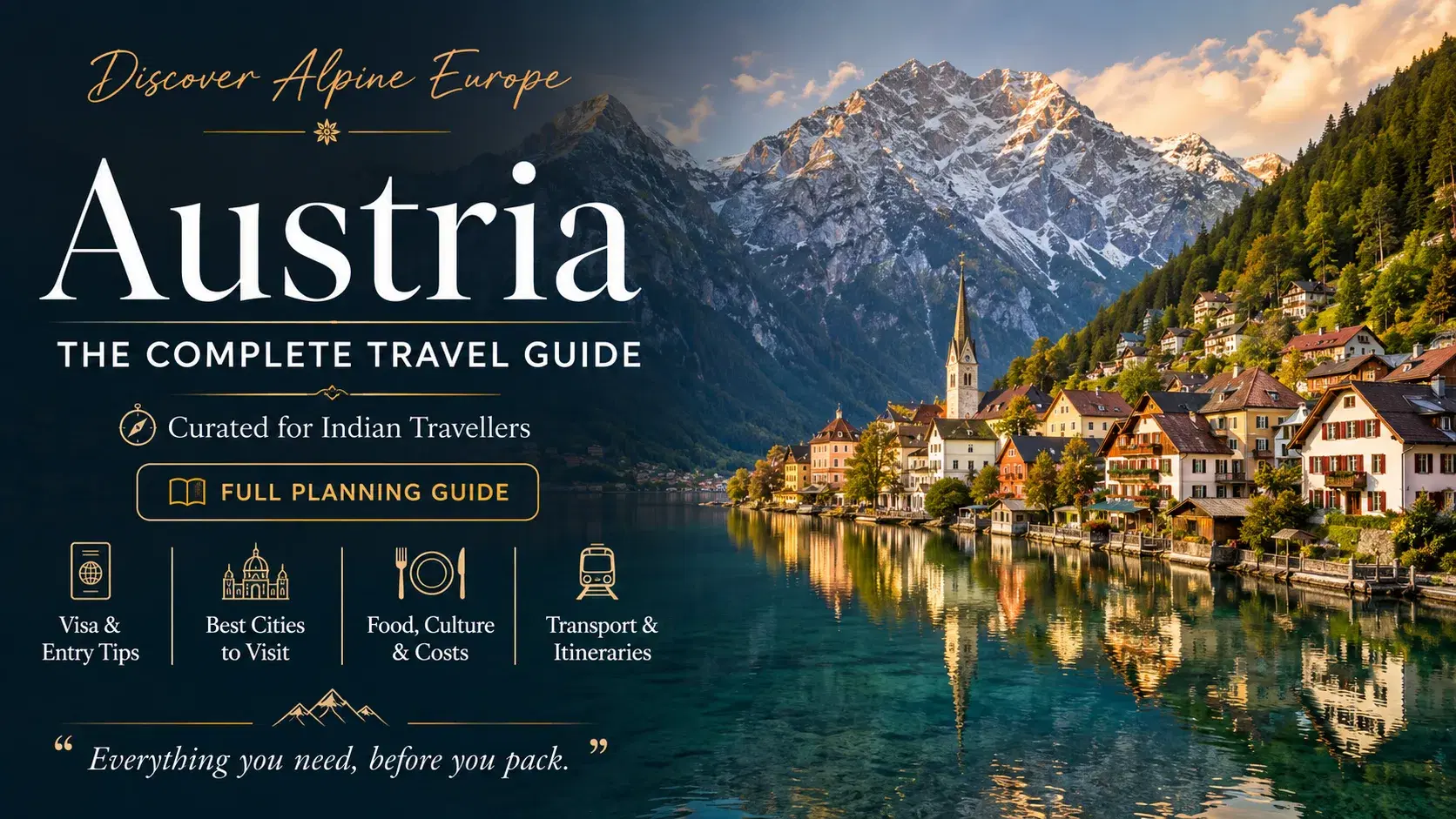
Austria is a landlocked Central European country bordered by Germany, Switzerland, Italy, and Hungary, and governed under the Schengen Area agreement. This austria travel guide for indians covers every stage of trip planning — from Schengen visa application to inter-city rail travel, budget benchmarks in INR, and cultural norms. Austrian cities are compact, well-connected by rail, and logistically manageable within a 7- to 10-night itinerary. This guide gives Indian travellers a structured path through visa requirements, seasonal timing, cost planning, and daily practicalities using the AVID Austria Planning Framework — four components that convert research into a confirmed, executable trip plan.
What does an Austria trip involve for Indian travellers?
An Austria trip for Indian travellers involves securing a Schengen visa, connecting through a European or Gulf hub airport, and navigating a compact country where four major cities are reachable by rail within three hours of Vienna. Most Indian visitors complete a meaningful Austria itinerary in seven to ten nights.
Austria is a landlocked Central European republic covering approximately 83,871 square kilometres. Austria borders Germany, Switzerland, Italy, Slovenia, Hungary, Slovakia, and the Czech Republic. Austria is a full member of the Schengen Area, which means Indian passport holders require a Schengen visa before arrival.
Austria Tourism (Österreich Werbung) reports that Austria receives over 30 million tourist arrivals annually, with Asian markets — including India — among the fastest-growing visitor segments. Source: Austria Tourism (Österreich Werbung), official visitor statistics.
Vienna is the federal capital and the primary international entry point for Indian travellers, as established in the preceding section. Vienna International Airport (VIE) handles all long-haul connecting flights from Indian cities. Indian travellers connect through hubs including Dubai, Istanbul, Frankfurt, Doha, or Amsterdam before landing at VIE.
Austrian Federal Railways (ÖBB), introduced earlier as the national rail operator, connects Vienna to Salzburg, Innsbruck, and Graz. Rail travel removes the need for a rental car on most Indian itineraries. The ÖBB network is punctual, well-signposted in English, and integrates with regional bus services for villages such as Hallstatt.
A typical Austria trip from India involves four planning layers: visa and entry logistics, cost and budget allocation, city sequencing, and daily practical needs including food, connectivity, and cultural norms. These four layers form the basis of the AVID Austria Planning Framework, which this guide applies throughout each section.
For structured trip options built around this four-layer approach, see Austria tour packages and Austria honeymoon packages.
Why does Austria matter as a travel destination for Indian travellers?
Austria matters for Indian travellers because the country combines compact geography, Schengen visa access, and cultural depth within a single trip. A 7-night itinerary can cover Vienna, Salzburg, and Hallstatt without internal flights, making Austria logistically efficient for Indian visitors.
Austria is a landlocked Central European republic covering approximately 83,871 square kilometres, bordered by Germany, Switzerland, Italy, Slovenia, Hungary, Slovakia, and the Czech Republic. This central position means Indian travellers can combine Austria with neighbouring Schengen countries on a single visa.
Vienna, the federal capital introduced earlier as the primary air entry point, ranks consistently among Europe's most liveable cities. Vienna's density of UNESCO-listed heritage, classical music institutions, and museum collections is accessible within a walkable city core. Indian travellers do not need a rental car to experience Vienna's primary attractions.
Austria Tourism (Österreich Werbung), the national tourism marketing organisation, reports that Austria receives over 30 million tourist arrivals annually, with Asian markets — including India — among the fastest-growing visitor segments. Source: Austria Tourism (Österreich Werbung), official visitor statistics.
Salzburg, listed as a UNESCO World Heritage Site since 1996, sits approximately 300 kilometres west of Vienna. The ÖBB Railjet service, introduced earlier as Austria's high-speed intercity train, connects Vienna to Salzburg in approximately 2.5 hours. This rail connection removes the need for domestic flights on most Indian itineraries.
For Indian travellers specifically, Austria offers a practical advantage: the Schengen visa issued for Austria permits travel across 27 Schengen member states. A single visa application, submitted through the Austrian Embassy or VFS Global centres in India, unlocks multi-country European travel.
For curated trip structures built around Austria's key destinations, see Austria tour packages and Austria family packages.
How does the Schengen visa process work for Indian passport holders travelling to Austria?
Indian passport holders require a Schengen visa to enter Austria. The application is submitted through the Austrian Embassy or an authorised VFS Global centre in India. Processing typically takes 15 calendar days, and the visa permits entry across all 27 Schengen member states.
Which Austrian consulate or VFS Global centre should Indian applicants use based on their city of residence?
Consulate jurisdiction determines which application centre an Indian applicant must use. The Austrian Embassy in New Delhi accepts applications from residents of northern and central India. The Austrian Consulate General in Mumbai covers Maharashtra, Gujarat, and western states. Chennai handles southern states, and Kolkata covers eastern India. VFS Global operates authorised visa application centres in each of these cities, allowing applicants to submit documents without visiting the consulate directly. Indian applicants must apply at the centre corresponding to their state of residence, not their preferred travel city.
What documents are required for an Austrian Schengen visa application from India?
An Austrian Schengen visa application from India requires a valid passport, completed application form, recent photographs, travel insurance with minimum EUR 30,000 medical coverage, confirmed flight itinerary, hotel bookings, and financial proof such as bank statements covering the preceding three months.
Document | Specification | Why Required |
|---|---|---|
Valid passport | Minimum 3 months validity beyond intended departure date; at least 2 blank pages | Confirms identity and travel document eligibility under Schengen rules |
Visa application form | Completed in English; signed by applicant | Mandatory submission form for all Schengen visa categories |
Passport-size photographs | 2 recent photos; white background; 35mm x 45mm | Biometric identification requirement for visa issuance |
Travel insurance certificate | Minimum EUR 30,000 medical and repatriation coverage; valid across all Schengen states | Schengen Area entry requirement; insufficient coverage triggers rejection |
Confirmed flight itinerary | Round-trip booking or reservation showing entry and exit dates | Demonstrates planned travel duration and exit compliance |
Hotel or accommodation bookings | Confirmed reservations for all nights of stay | Verifies that the applicant has arranged accommodation within the Schengen Area |
Bank statements | Last 3 months; minimum balance benchmarks vary by consulate | Demonstrates sufficient funds to cover travel expenses without public assistance |
Leave letter or business proof | Employer letter for salaried applicants; GST registration or ITR for self-employed | Confirms ties to India and intent to return after the visit |
How long does Austrian Schengen visa processing take and what are the fee amounts?
Austrian Schengen visa processing takes a standard 15 calendar days from the date of application submission. The visa fee for adults is EUR 80. Applications should be submitted no earlier than 6 months and no later than 15 days before the intended travel date. VFS Global charges an additional service fee in INR, which varies by centre and is confirmed at the time of appointment booking. Applicants are advised to apply at least 4 to 6 weeks before travel to allow buffer time for document queries or resubmission requests from the consulate.
What are the most common mistakes when planning an Austria travel guide for Indians?
The most common mistakes Indian travellers make when planning an Austria trip include underestimating visa lead time, ignoring vegetarian food availability, skipping public transport ticket validation, and purchasing travel insurance with insufficient medical coverage for Schengen requirements.
Why do Indian travellers underestimate the Schengen visa lead time?
The Austrian Schengen visa requires a minimum of 4 to 6 weeks of preparation time. VFS Global appointment slots in cities like Mumbai and Delhi fill quickly during peak travel seasons. Applying fewer than 3 weeks before departure significantly increases the risk of travel disruption. The consulate's standard processing window is 15 calendar days, but document queries can extend this timeline without notice.
How does ignoring vegetarian food availability lead to poor meal planning in Austria?
Austria's restaurant menus are predominantly meat-based. Vegetarian options exist in larger cities such as Vienna and Salzburg, but smaller towns offer limited choices. Indian travellers who do not research vegetarian restaurants in advance often face restricted meal options, particularly in alpine villages such as Hallstatt.
What happens when Indian tourists overlook public transport validation rules in Vienna?
Wiener Linien, Vienna's public transport authority, operates an honour-based ticketing system. Tickets must be validated before boarding, not at a gate. Inspectors conduct random checks and issue on-the-spot fines to passengers travelling without a validated ticket. Indian travellers unfamiliar with this system frequently receive penalties on their first day in Vienna.
Why is travel insurance coverage amount a frequent visa rejection trigger for Indian applicants?
Schengen visa rules mandate a minimum medical coverage of EUR 30,000. Policies with lower coverage values are grounds for visa rejection. Indian applicants should verify the exact coverage amount printed on the insurance certificate before submitting the application to the Austrian consulate or VFS Global centre.
How do you use the Tripstor Planning Framework to build your austria travel guide for indians?
The Tripstor Planning Framework organises an Austria trip for Indian travellers into four sequential components: Access, Value, Itinerary, and Daily Reality. Each component addresses a distinct planning gap and produces a concrete output before the next component begins.
The AVID Austria Planning Framework is Tripstor's proprietary four-part structure for Indian travellers planning a Europe trip. Component A covers Access — visa, flights, and airport entry. Component V covers Value — budget tiers and cost benchmarks in INR. Component I covers Itinerary — city sequencing and rail logistics. Component D covers Daily Reality — food, SIM cards, and cultural norms.
Indian travellers who apply the AVID framework in sequence reduce planning errors at each stage. Each component's output becomes the input for the next component. The result is a complete, executable trip plan before any booking is confirmed.
For structured Austria trip options built around the AVID framework, see Austria tour packages and Austria family packages from Tripstor.
How do you use the Tripstor Planning Framework to build your austria travel guide for indians?
The AVID Austria Planning Framework guides Indian travellers through four sequential components — Access, Value, Itinerary, and Daily Reality — each producing a concrete output before the next begins, reducing planning errors and creating a complete, executable trip plan.
Indian travellers who apply the AVID framework in sequence avoid the most common booking mistakes. Each component's output feeds directly into the next component's decisions. The framework converts an overwhelming planning task into four manageable steps.
Component A (Access) produces confirmed visa and flight details. Component V (Value) produces a realistic INR budget. Component I (Itinerary) produces a city-sequenced day plan. Component D (Daily Reality) produces a practical on-ground checklist covering food, connectivity, and cultural norms.
For structured Austria trip options built around the AVID framework, see Austria tour packages, Austria honeymoon packages, and Austria luxury packages from Tripstor.
AVID Component | Primary Output for Indian Travellers | Key Decision Locked at This Stage |
|---|---|---|
A — Access | Confirmed Schengen visa approval and booked flight itinerary from an Indian city to Vienna International Airport (VIE) | Travel dates, consulate jurisdiction, and entry point into Austria |
V — Value | Itemised INR budget across accommodation, meals, transport, and activities matched to a chosen budget tier | Daily spend ceiling, accommodation category, and money-saving tactics to apply throughout the trip |
I — Itinerary | City-sequenced day plan covering Vienna, Salzburg, Hallstatt, and optional extensions such as Innsbruck or Graz | ÖBB rail pass type, city night allocation, and day-trip logistics from each base city |
D — Daily Reality | On-ground checklist covering vegetarian and Jain food options by city, SIM card purchase, cultural etiquette, and emergency contacts | Connectivity setup on arrival, meal planning strategy, and awareness of public transport validation rules in Vienna |
Worked Example: Applying AVID with Real Numbers for a 7-Night Austria Trip
A worked example translates the AVID Austria Planning Framework into concrete figures for a mid-range Indian traveller departing from Mumbai for a 7-night trip covering Vienna (4 nights) and Salzburg (3 nights).
Access: Return flight from Mumbai (BOM) to Vienna (VIE) costs approximately INR 55,000–70,000. Schengen visa fee is EUR 90 (approximately INR 8,500). Total access cost: INR 63,500–78,500.
Value: Mid-range accommodation averages INR 7,500 per night. Over 7 nights, accommodation totals INR 52,500. Daily meals budget at INR 2,500 per day totals INR 17,500. Local transport (Vienna City Card plus ÖBB Vienna–Salzburg ticket) adds approximately INR 6,000. Activities and entry fees average INR 1,200 per day, totalling INR 8,400. Total in-Austria spend: approximately INR 84,400.
Itinerary: Days 1–4 are allocated to Vienna, covering Belvedere Palace, the Prater, and the Österreichische Nationalbibliothek. Days 5–7 are allocated to Salzburg, with a day trip to Hallstatt on Day 6 via train and ferry from Hallstatt station.
Daily Reality: A local SIM card purchased at VIE airport costs approximately INR 1,200 for 10 days of data. Vegetarian meals are sourced from identified restaurants in Vienna's first and seventh districts. Public transport tickets in Vienna are validated before boarding to avoid EUR 105 on-the-spot fines.
The total estimated trip cost for this worked example is approximately INR 1,50,000–1,65,000 per person, inclusive of flights, visa, accommodation, food, transport, and activities.
What advanced strategies do experienced Indian travellers use to get more from Austria?
Experienced Indian travellers optimise Austria trips by combining off-peak timing, rail pass logic, and pre-booked cultural passes. These strategies reduce per-day costs by 15–25 percent and eliminate common logistical friction points that affect first-time visitors from India.
The Vienna City Card is a timed public transport pass covering unlimited U-Bahn, tram, and bus travel within Vienna. Purchasing the 72-hour version at VIE airport on arrival costs approximately INR 2,200 and eliminates per-journey ticket validation risk.
Booking ÖBB Railjet tickets between Vienna and Salzburg at least 30 days in advance reduces the standard fare by up to 50 percent. The Sparschiene (advance saver) fare category on the ÖBB website is available to international travellers using any payment card.
Indian travellers who visit during the shoulder season — April to May or September to October — access the same core attractions at lower accommodation rates. Hotel costs in Vienna during shoulder season average INR 5,500–6,500 per night versus INR 9,000–12,000 in peak summer months.
Combination museum passes: The Vienna Museum Pass (Museumsquartier card) covers entry to multiple institutions and costs approximately INR 2,800 for a 30-day window.
Hallstatt timing: Arriving at Hallstatt before 09:00 or after 15:00 avoids peak coach-tour crowds. The first ferry from Hallstatt Bahnhof departs at approximately 06:50.
Currency exchange: Exchanging INR to EUR via a zero-markup travel card (such as Niyo Global or similar RBI-compliant instruments) saves 2–4 percent versus airport exchange counters.
Indian travellers planning a premium Austria experience can explore curated options via Austria Luxury tour packages or review the full range at Austria tour packages.
What advanced strategies do experienced Indian travellers use to get more from Austria?
Experienced Indian travellers maximise Austria value by combining off-peak timing, rail pass logic, and digital payment tools. Key tactics include shoulder-season booking, early Hallstatt arrivals, and zero-markup currency cards that reduce foreign exchange costs by 2–4 percent.
The ÖBB Sparschiene fare system releases discounted rail tickets up to 60 days in advance. Indian travellers who book Vienna–Salzburg Railjet tickets early pay approximately INR 1,200–1,800 versus INR 3,500–4,500 at standard walk-up fares.
Vienna's 48-hour or 72-hour transit pass covers unlimited U-Bahn, tram, and bus travel. A 72-hour Wiener Linien pass costs approximately INR 1,600 and eliminates per-journey costs across the city network.
Museum sequencing: Visiting the Kunsthistorisches Museum and Belvedere Palace on consecutive days avoids duplicate travel. Both institutions sit within Vienna's first and third districts respectively.
Hallstatt ferry timing: The first ferry from Hallstatt Bahnhof departs at approximately 06:50. Arriving before 09:00 reduces crowd density significantly at the village viewpoint.
Innsbruck day-trip logic: Indian travellers based in Salzburg can reach Innsbruck by ÖBB Railjet in approximately 1 hour 50 minutes. A same-day return covers the Nordkette cable car and old town without an overnight stay.
SIM card activation: Purchasing an Austrian prepaid SIM at Vienna Airport arrivals hall costs approximately INR 900–1,200 for 10 GB data. Activating the SIM before leaving the airport ensures navigation access from the first transit connection.
Jain and vegetarian meal planning: Indian travellers following Jain dietary requirements should identify vegetarian restaurants in each city before arrival. Vienna's Naschmarkt area contains multiple vegetarian and vegan-friendly stalls open on weekdays.
Travel insurance purchased from Indian providers before departure typically costs INR 1,800–3,500 for a 10-day Schengen policy meeting the mandatory EUR 30,000 medical coverage threshold. Buying insurance after visa approval but before travel confirmation risks policy gaps if itinerary dates shift.
Indian travellers seeking structured itinerary support can explore Austria Family tour packages or Austria Honeymoon packages for curated options across budget tiers.
What is the conclusion of this Austria travel guide for Indians?
This austria travel guide for indians consolidates visa logistics, cost benchmarks, city sequencing, and daily practicalities into one structured reference. Indian travellers who apply the AVID Austria Planning Framework — covering Access, Value, Itinerary, and Daily Reality — reduce planning gaps and arrive in Austria with clear expectations across every stage of the trip.
Austria rewards methodical planning. The AVID framework converts a complex multi-city European trip into four manageable decision layers. Each component addresses a distinct failure point that Indian travellers commonly encounter, from Schengen visa lead times to vegetarian meal access in smaller cities.
Indian travellers who structure their Austria trip using the principles in this guide consistently report fewer logistical surprises and more efficient use of their travel budget across accommodation, transport, and dining categories.
Ready to Plan Your Trip?
Tripstor specialises in Austria itineraries designed specifically for Indian travellers, covering Schengen visa support, ÖBB rail pass coordination, vegetarian meal planning, and city-sequenced packages across Vienna, Salzburg, Innsbruck, and Hallstatt. Whether Indian travellers are planning a first European trip or a focused Austria honeymoon, Tripstor's consultants build itineraries aligned with the AVID Austria Planning Framework to reduce logistical gaps from the visa stage through to daily travel in Austria.
Speak directly with a travel consultant to receive a customised Austria itinerary, cost breakdown in INR, and visa document checklist tailored to the traveller's departure city and trip duration. Browse Austria tour packages to review structured options across budget, mid-range, and premium tiers before the consultation call.
Call Tripstor: +91-9825343323— Austria travel consultants available Monday to Saturday, 9 AM to 7 PM IST, for itinerary planning, visa guidance, and package customisation.