
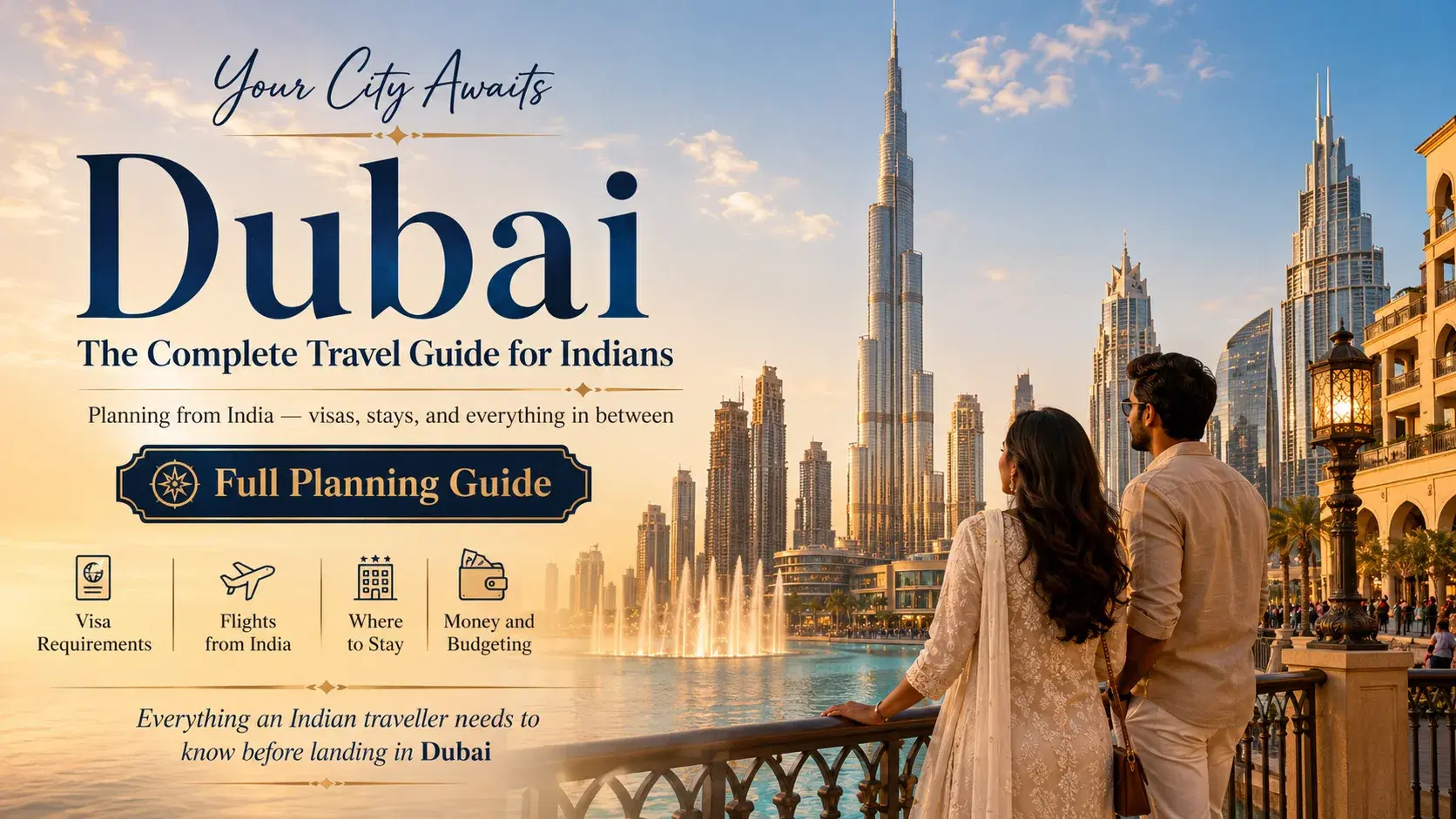
Dubai is a city-state in the United Arab Emirates and one of the most visited international destinations for Indian travellers. This Dubai travel guide for Indians addresses the specific planning friction points Indian passport holders face — visa pathways, costs in INR, direct flight options, cultural conduct rules, and practical logistics. The DICE Planning Framework structures this guide across six core topics: entry documents, timing, transport, budgeting, itinerary, and experience etiquette.
What documents and entry requirements do Indians need for Dubai?
Indian passport holders can enter Dubai through two pathways: a pre-approved e-visa obtained before travel, or a visa on arrival available to those holding a valid US, UK, or EU Schengen visa. Passport validity must be at least six months beyond the intended travel date.
What is Dubai as a travel destination for Indian nationals?
Dubai is a city-emirate in the United Arab Emirates that functions as a major international tourism hub. For Indian nationals, Dubai combines geographic proximity, direct flight connectivity, a large Indian expatriate community, and a wide range of experiences across heritage, luxury, and outdoor activities.
Dubai sits on the southeastern coast of the Arabian Peninsula. The emirate covers approximately 4,114 square kilometres and is governed under the UAE federal structure. Dubai's appeal for Indian travellers rests on four converging factors: short flight duration, visa accessibility, INR-friendly mid-range pricing, and cultural familiarity through a large Indian diaspora.
The Indian community in Dubai represents one of the largest expatriate groups in the UAE. This presence means Indian restaurants, Hindi-speaking service staff, and Indian grocery stores are widely available across the city. Indian travellers encounter fewer language and dietary barriers in Dubai than in most long-haul destinations.
Dubai operates two primary airports. Dubai International Airport (DXB) is the main gateway and holds the IATA code DXB. Dubai World Central (DWC), also called Al Maktoum International Airport, handles select low-cost and cargo operations. Most direct flights from India arrive at DXB.
The city divides into distinct zones with different characters. Deira and Bur Dubai form the historic trading core. Downtown Dubai anchors the modern skyline around the Burj Khalifa. Dubai Marina and Jumeirah Beach Residence offer waterfront dining and leisure. Palm Jumeirah extends into the Arabian Gulf as an artificial archipelago hosting luxury resorts.
Dubai's regulatory body for tourism is the Department of Economy and Tourism, commonly referred to as DTCM. DTCM issues tourism licences, publishes visitor guidelines, and tracks inbound visitor statistics. India consistently ranks among the top three source markets in DTCM annual visitor data.
Why does timing and preparation matter for Indian travellers planning Dubai?
Timing a Dubai trip correctly determines comfort, cost, and cultural experience. Indian travellers who plan around Dubai's climate calendar and festival calendar spend less on flights, avoid extreme heat, and encounter fewer logistical surprises during their visit.
Dubai's climate divides into two distinct periods. The cooler period runs from October through April, with daytime temperatures between 18°C and 30°C. The hotter period runs from May through September, with temperatures regularly exceeding 42°C and high humidity near the coast.
October to March is the optimal travel window for Indian visitors seeking outdoor sightseeing, beach access, and comfortable walking conditions across the city's major zones.
Flight prices from Indian cities follow a predictable seasonal pattern. December and January represent peak pricing, driven by school holidays and New Year demand. March through April and October through November offer shoulder-season fares that are typically 20–30 percent lower than peak rates.
India consistently ranks among the top three source markets for Dubai tourism by visitor volume — source: DTCM Annual Visitor Report
Ramadan, the Islamic holy month, shifts the Dubai experience significantly. Restaurant and café operating hours change during Ramadan, with most venues closing during daylight hours and reopening after sunset. Eating, drinking, and smoking in public spaces during daylight is prohibited under UAE law and applies equally to tourists.
Ramadan also brings distinct advantages. Iftar experiences at hotels and restaurants offer Indian travellers access to curated multi-cuisine spreads. Ramadan Night Markets operate across the city during evening hours. Hotel rates during Ramadan are often lower than in the peak winter season.
Indian travellers should confirm Ramadan dates before booking, as the Islamic calendar shifts the month forward by approximately 10 days each year. Booking hotels and flights at least six to eight weeks in advance secures better rates across all seasons.
How does getting around Dubai work for Indian visitors?
Getting around Dubai involves four main transport modes: the Dubai Metro, RTA taxis, ride-hailing apps, and water taxis. Indian visitors arriving at Dubai International Airport can reach most tourist zones within 30 to 45 minutes using the Metro Red Line.
How does the Dubai Metro work and is it useful for Indian tourists?
The Dubai Metro is a driverless, air-conditioned rapid transit network operated by the Roads and Transport Authority (RTA). The Metro covers the primary tourist corridors used by Indian visitors.
The Red Line connects Dubai International Airport Terminal 1 and Terminal 3 to Downtown Dubai, Mall of the Emirates, and Dubai Marina. The Green Line serves Deira, Bur Dubai, and the Gold Souk area.
Indian travellers purchase a Nol Card to use the Metro. The Nol Card is a reloadable contactless transit card available at all Metro stations. Nol Cards work on Metro trains, RTA buses, and water buses across Dubai.
A single Metro journey costs between AED 2 and AED 8.50 depending on the fare zone. The AED-to-INR equivalent ranges from approximately INR 44 to INR 187 per trip. The Metro operates from 05:00 to midnight on weekdays and until 01:00 on weekends.
Should Indian tourists rent a car or use public transport in Dubai?
Car rental in Dubai requires an International Driving Permit (IDP) for Indian licence holders. Dubai follows right-hand traffic rules, which differ from India's left-hand system.
Dubai enforces a zero-alcohol-tolerance policy for drivers. Any detectable blood alcohol level results in immediate arrest and licence confiscation under UAE traffic law.
For most Indian tourists on a 4 to 7 night trip, the Metro combined with Careem or Uber covers all major zones cost-effectively. Car rental becomes practical only for day trips outside the city, such as visits to Al Ain or Hatta.
What cultural and legal rules do Indians need to follow in Dubai?
Dubai enforces conduct laws that carry criminal penalties for violations. Indian travellers must understand these rules before arrival, not after.
Public display of affection — including kissing or embracing in public — is prohibited under UAE law. Violations can result in fines or arrest, regardless of the couple's marital status.
Alcohol consumption is permitted only inside licensed venues such as hotels, restaurants, and designated bars. Drinking in public spaces, on beaches, or in vehicles is a criminal offence under UAE Penal Code provisions.
Photography near government buildings, military installations, and airports is prohibited in Dubai. Photographing individuals without their explicit consent is also restricted and can result in legal complaints under UAE privacy law.
Dress code requirements apply across all public spaces in Dubai. Modest clothing — covering shoulders and knees — is required in malls, souks, and public transport. Swimwear is acceptable only at beaches and hotel pools.
Posting content on social media that is deemed offensive to the UAE government, its leaders, or its religion constitutes a criminal offence. The UAE Cybercrime Law imposes imprisonment and fines for such violations, and Indian nationals are not exempt.
Certain prescription medications commonly used in India — including codeine-based painkillers and some psychotropic drugs — are classified as controlled substances in the UAE. Indian travellers carrying such medications must obtain prior approval from the UAE Ministry of Health and Prevention (MOHAP) before travel.
What financial mistakes do Indian travellers make in Dubai?
Currency exchange at Dubai International Airport (DXB) consistently offers rates less favourable than city exchange centres. Indian travellers who exchange Indian rupees (INR) to UAE Dirham (AED) at the airport typically receive 3 to 5 percent less value per transaction.
Established exchange houses such as Al Fardan Exchange and UAE Exchange, located across Dubai's commercial districts, offer significantly better rates. A forex card loaded with AED before departure from India provides another cost-effective alternative to airport counters.
What are the most common mistakes when planning a Dubai travel guide for Indians?
Indian travellers planning a Dubai trip most commonly make errors across three categories: cultural and legal conduct, financial decisions, and logistical preparation. Addressing these gaps before departure prevents fines, delays, and unnecessary overspending during the trip.
Dubai operates under UAE federal law, which differs significantly from Indian legal norms. Several actions that are socially accepted in India carry criminal penalties in Dubai. Understanding these distinctions is not optional — it is a prerequisite for a safe visit.
What cultural and legal rules do Indians need to follow in Dubai?
Public display of affection — including kissing or embracing in public spaces — is prohibited under UAE public decency laws. Violations can result in fines or arrest. This rule applies to all visitors regardless of nationality or marital status.
Alcohol consumption in Dubai is permitted only within licensed venues such as hotel bars and designated restaurants. Drinking in public spaces, on beaches, or in vehicles is illegal. Public intoxication carries a criminal penalty under UAE law.
Photography near government buildings, military installations, and Dubai International Airport (DXB) is prohibited. Indian travellers must also obtain consent before photographing individuals, particularly women, in public spaces.
Dress code requirements apply across all public areas including malls, souks, and transport. Swimwear is restricted to beaches and pool areas. Modest clothing — covering shoulders and knees — is the standard expectation in non-beach public spaces.
Posting content on social media that criticises the UAE government, its leaders, or its religion constitutes a criminal offence. The UAE Cybercrime Law imposes imprisonment and fines for such violations, and Indian nationals are not exempt.
Certain prescription medications commonly used in India — including codeine-based painkillers and some psychotropic drugs — are classified as controlled substances in the UAE. Indian travellers carrying such medications must obtain prior approval from the UAE Ministry of Health and Prevention (MOHAP) before travel.
What financial mistakes do Indian travellers make in Dubai?
Currency exchange at Dubai International Airport (DXB) consistently offers rates less favourable than city exchange centres. Indian travellers who exchange Indian rupees (INR) to UAE Dirham (AED) at the airport typically receive 3 to 5 percent less value per transaction.
Established exchange houses such as Al Fardan Exchange and UAE Exchange, located across Dubai's commercial districts, offer significantly better rates. A forex card loaded with AED before departure from India provides another cost-effective alternative to airport counters.
How do you use the Tripstor Planning Framework to build a complete Dubai travel guide for Indians?
The Tripstor DICE Planning Framework organises a Dubai trip from India into four sequential components: Documents and Entry, Itinerary Architecture, Cost Calibration, and Experience and Etiquette. Indian travellers who apply all four components reduce planning errors and arrive with a realistic, fully costed itinerary.
The DICE Planning Framework is a proprietary four-part structure developed to address the specific friction points Indian nationals face when planning a Dubai trip. Each component builds on the previous one, moving from legal eligibility through to on-ground conduct.
D — Documents and Entry: Confirms visa pathway (e-visa or visa on arrival), passport validity, travel insurance, and customs compliance before any booking is made.
I — Itinerary Architecture: Structures daily movement across Dubai's four primary zones — Old Dubai, Downtown, Dubai Marina, and day-trip corridors — to minimise transit time and maximise experience density.
C — Cost Calibration: Converts all trip costs into INR across three budget tiers — budget, mid-range, and premium — covering flights, hotel, visa fees, activities, and daily food spend.
E — Experience and Etiquette: Maps UAE cultural conduct rules, dress code requirements, Ramadan protocols, and photography restrictions that directly affect Indian travellers.
Applying the DICE framework in sequence prevents the most common planning failure among Indian travellers: booking flights and hotels before confirming visa eligibility or understanding the true INR cost of the trip.
How do you use the Tripstor Planning Framework to build a complete Dubai travel guide for Indians?
The Tripstor DICE Planning Framework organises a Dubai trip from India into four sequential components — Documents, Itinerary, Cost, and Experience — so that each decision is made in the correct order before the next stage begins.
Most Indian travellers encounter avoidable problems because planning steps are completed out of sequence. Flights get booked before visa eligibility is confirmed. Hotels are selected before daily movement zones are mapped. The DICE framework prevents these errors by enforcing a logical dependency chain across all four planning components.
Applying DICE in full produces a trip plan that is legally compliant, financially calibrated in INR, and culturally informed before any payment is made. Each component feeds directly into the next, reducing replanning and unexpected costs on the ground in Dubai.
DICE Component | Planning Actions Covered | Output Produced |
|---|---|---|
D — Documents and Entry | Confirm visa pathway (e-visa or VOA); verify passport validity; arrange travel insurance; check customs rules for restricted items | A legally compliant entry file ready before any booking is made |
I — Itinerary Architecture | Map daily movement across Old Dubai, Downtown, Marina, and day-trip zones; sequence attractions by geographic proximity | A zone-based day plan that minimises transit time and maximises coverage |
C — Cost Calibration | Build a full INR budget across flights, hotel, visa fees, activities, food, and local transport; assign tier options (budget, mid-range, premium) | A verified INR spend figure before any payment is committed |
E — Experience and Etiquette | Review UAE conduct laws, dress code rules, Ramadan protocols, photography restrictions, and medication declaration requirements | A cultural compliance checklist that prevents legal and social errors on the ground |
DICE in Practice: A Worked Example for Two Indian Travellers on a 5-Night Dubai Trip
The DICE Planning Framework produces concrete numbers when applied to a real trip scenario. The following example uses a couple travelling from Mumbai to Dubai for five nights, targeting a mid-range budget tier.
D — Documents and Entry: Two 30-day e-visas via DNATA cost approximately INR 7,000 per person (INR 14,000 total). Travel insurance for two travellers adds roughly INR 2,500 for the trip duration.
I — Itinerary Architecture: Days 1–2 cover Old Dubai (Deira Gold Souk, Spice Souk, abra crossing, Dubai Frame). Day 3 covers Downtown Dubai (Burj Khalifa floor 124 tickets at INR 2,200 per person, Dubai Mall). Day 4 covers Dubai Marina and JBR Beach. Day 5 covers a licensed desert safari from Dubai Desert Conservation Reserve, including dune bashing and BBQ dinner at approximately INR 3,500 per person.
C — Cost Calibration: Return flights from Mumbai to Dubai (DXB) on IndiGo or Air India average INR 18,000–24,000 per person in shoulder season. A mid-range hotel in Bur Dubai or Downtown costs INR 5,500–8,000 per night. Total estimated spend for two travellers across five nights: INR 1,40,000–1,65,000, inclusive of visa fees, flights, accommodation, activities, meals, and local transport.
E — Experience and Etiquette: The couple reviews UAE public conduct rules before departure — confirming that public display of affection carries legal risk, that alcohol is only consumed inside licensed venues, and that modest clothing is required in souks and malls.
This worked example confirms that the DICE framework converts abstract planning into a verified INR figure before any payment is committed, reducing the risk of budget overrun on the ground.
What advanced strategies do experts use when planning a Dubai trip from India?
Expert Dubai trip planners from India use four advanced strategies: stacking visa eligibility checks before booking flights, anchoring hotel selection to metro corridors, pre-purchasing attraction tickets to avoid dynamic pricing, and separating discretionary spend from fixed costs in INR budgets.
Visa eligibility verification is the first non-negotiable step before any flight or hotel payment is committed. Indian passport holders who hold a valid US, UK, or EU Schengen visa qualify for visa on arrival at Dubai International Airport. Confirming this eligibility before booking eliminates the DNATA e-visa processing window of three to five working days.
Hotel selection anchored to the Dubai Metro Red Line reduces daily transport costs significantly. Properties within 500 metres of a Red Line station — such as those near Union, BurJuman, or Dubai Mall/Burj Khalifa stations — allow travellers to avoid taxi fares for most sightseeing days. A Nol Card, the reloadable transit card issued by RTA, covers metro, bus, and water bus fares on a single balance.
Pre-purchasing attraction tickets eliminates on-the-day price surges. Burj Khalifa floor 124 tickets purchased via the official website cost less than tickets bought at the Dubai Mall counter on the same day. The price differential can reach AED 50–80 per person, equivalent to INR 1,100–1,800 per person.
Separating fixed costs from discretionary spend gives Indian travellers a clearer INR ceiling. Fixed costs — flights, visa, hotel, and pre-booked activities — are confirmed before departure. Discretionary spend — dining upgrades, unplanned shopping, and optional tours — is capped as a separate daily allowance in AED loaded onto a forex card.
What advanced strategies help Indian travellers reduce Dubai trip costs further?
Advanced cost reduction for Indian travellers in Dubai combines transit eligibility checks, accommodation placement near the Dubai Metro Red Line, pre-purchased attraction tickets, and a structured separation of fixed versus discretionary spend in AED and INR.
Travellers holding a valid US, UK, or EU Schengen visa qualify for visa on arrival at Dubai International Airport, eliminating the DNATA e-visa processing window of three to five working days entirely.
Hotel selection anchored to the Dubai Metro Red Line reduces daily transport costs significantly. Properties within 500 metres of a Red Line station — near Union, BurJuman, or Dubai Mall/Burj Khalifa stations — allow travellers to avoid taxi fares on most sightseeing days. A Nol Card, the reloadable transit card issued by RTA, covers metro, bus, and water bus fares on a single balance.
Pre-purchasing Burj Khalifa floor 124 tickets via the official website costs less than counter tickets purchased at Dubai Mall on the same day. The price differential reaches AED 50–80 per person, equivalent to approximately INR 1,100–1,800 per person.
Separating fixed costs from discretionary spend gives Indian travellers a clearer INR ceiling before departure. Fixed costs — flights, visa, hotel, and pre-booked activities — are confirmed in advance. Discretionary spend — dining upgrades, unplanned shopping, and optional tours — is capped as a separate daily allowance loaded onto a forex card in AED.
Conclusion: Using the DICE Planning Framework to Finalise Your Dubai Trip from India
This dubai travel guide for indians has structured every planning decision around the DICE Planning Framework — covering Documents and Entry, Itinerary Architecture, Cost Calibration, and Experience and Etiquette. Indian travellers who apply all four components before departure reduce on-ground friction significantly and control total trip spend in INR with greater accuracy.
Visa pathway selection, zone-based itinerary design, INR cost benchmarking, and cultural conduct awareness are not isolated tasks. Each component of the DICE framework connects directly to the next. A traveller who completes all four stages arrives in Dubai with confirmed entry documents, a logical sightseeing sequence, a pre-set budget ceiling, and a clear understanding of UAE conduct laws.
Dubai rewards structured planning. Travellers who treat this guide as a pre-departure checklist — not a casual read — consistently report fewer surprises and more purposeful experiences across the city's distinct zones.
Ready to Plan Your Trip?
Tripstor's Dubai travel specialists work with Indian travellers to build itineraries that align with the DICE Planning Framework — covering visa processing, INR-calibrated budgets, zone-based sightseeing sequences, and cultural conduct briefings before departure.
Speak directly with a consultant to confirm your visa pathway, lock in flight and hotel combinations within your INR budget, and receive a pre-departure checklist tailored to your travel dates and group type.
Call Tripstor: +91-9825343323— Dubai trip planning for Indian travellers, Monday to Saturday, 9 AM to 7 PM IST.