
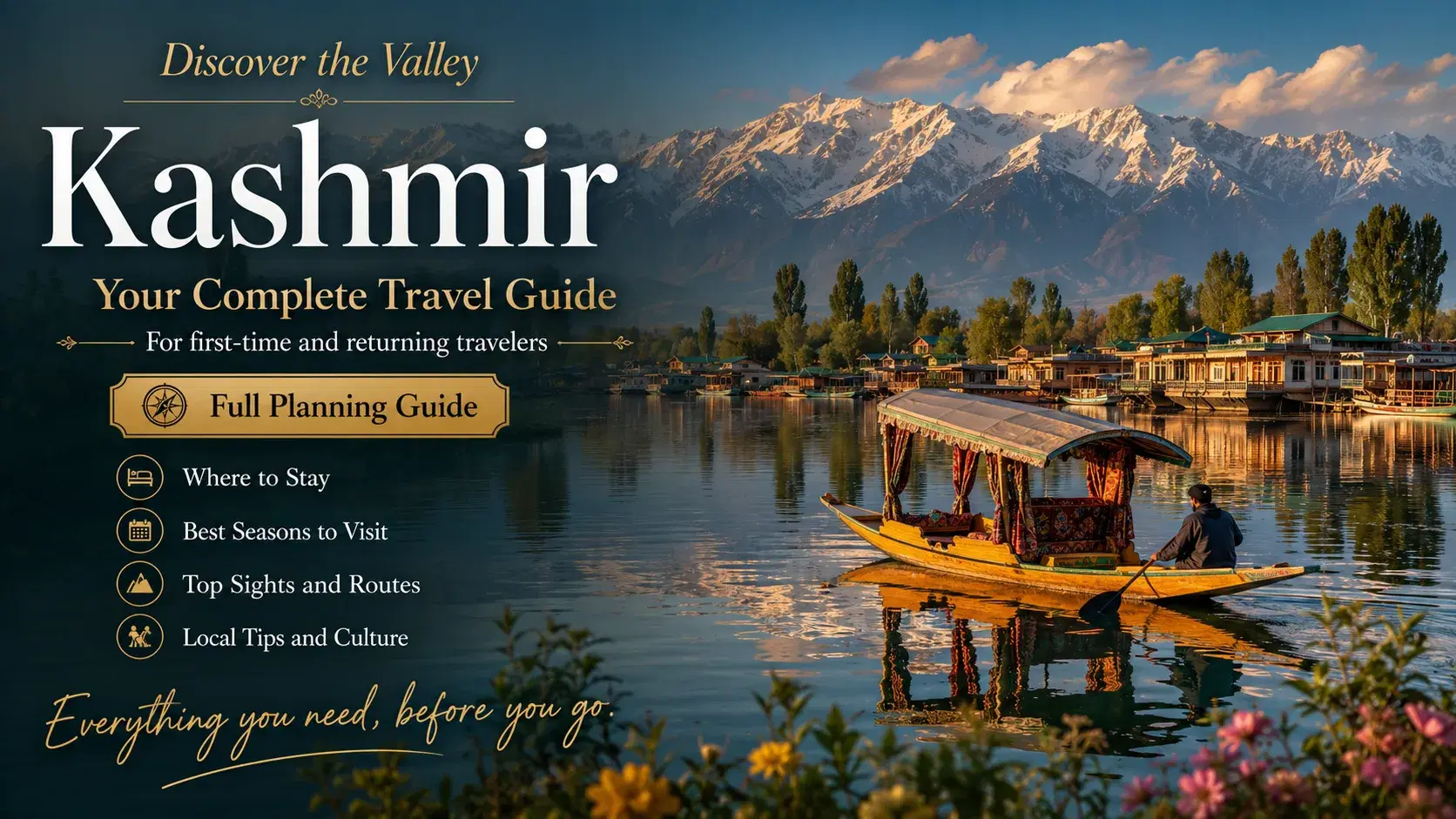
Kashmir is a high-altitude valley in northern India, forming the core of the Union Territory of Jammu and Kashmir. This kashmir travel guide addresses a persistent planning problem: reliable information about Kashmir is scattered across sources that ignore seasonal nuance, regional logistics, and permit requirements. This guide consolidates seasons, regions, itineraries, costs, documentation, and a proprietary planning framework into one structured resource.
Why does seasonal timing matter when planning a Kashmir trip?
Seasonal timing in Kashmir determines which destinations are accessible, which activities are available, and what road conditions a traveller will face. Kashmir experiences four distinct seasons — spring, summer, autumn, and winter — each serving a different primary trip purpose.
What is Kashmir like in spring (March to May)?
Spring in Kashmir runs from March to May. Srinagar temperatures range from approximately 5°C to 20°C during this period. The Tulip Garden in Srinagar — located in the Zabarwan foothills and claimed to be Asia's largest tulip garden — displays over 1.5 million bulbs across 30 or more varieties. Almond and cherry blossoms appear across the valley in March. Crowd levels are moderate before the April peak bloom period.
What is Kashmir like in summer (June to August)?
Summer is Kashmir's peak tourist season. The Sonamarg road opens around May and remains accessible through approximately November. The Amarnath Yatra pilgrimage window — set annually by the Shri Amarnathji Shrine Board — typically falls between June and August. Rainfall risk increases in July and August due to monsoon influence. Temperatures in Srinagar remain between 15°C and 30°C.
What is Kashmir like in autumn (September to November)?
Autumn brings post-monsoon clarity and the foliage of Chinar trees — Platanus orientalis — planted across Kashmir by Mughal emperors. Photography conditions are considered optimal in October. Tourist crowds thin noticeably after mid-September. Temperatures in Srinagar drop from around 15°C in September to near 5°C by November.
What is Kashmir like in winter (December to February)?
Winter activates Gulmarg as a skiing destination. Srinagar temperatures range from approximately −5°C to 5°C. The Sonamarg road and Mughal Road both close due to snowfall. Houseboats on Dal Lake operate with heating arrangements, though comfort levels vary by grade classification.
Gulmarg receives an average annual snowfall of approximately 4 to 6 metres, making Gulmarg one of the highest snowfall zones in the Indian subcontinent. — India Meteorological Department regional data
How does a Kashmir trip itinerary work from arrival to departure?
A Kashmir trip itinerary is structured around Srinagar as the central hub, with day trips or overnight stays radiating outward to Gulmarg, Pahalgam, and Sonamarg. Five days covers the core circuit; seven days allows deeper exploration of lesser-visited meadows and heritage sites.
Entry into Kashmir for most travellers begins at Srinagar International Airport, designated by IATA code SXR, which receives direct flights from Delhi, Mumbai, Bangalore, and Chennai. Road entry via NH-44 from Jammu is an alternative for travellers preferring a scenic overland approach.
What is the recommended day-by-day structure for a 5-day Kashmir trip?
Day 1 centres on Srinagar. Dal Lake is an approximately 18 sq km urban lake in Srinagar and serves as the orientation point for first-time visitors. A shikara ride on Dal Lake and a walk through Shalimar Bagh or Nishat Bagh grounds the traveller in the valley's Mughal heritage layer.
Day 2 covers Gulmarg. Gulmarg is a hill station in Baramulla district at 2,650 m elevation, known for the Gulmarg Gondola cable car reaching 3,979 m at Phase 2. The gondola ride and meadow walk constitute the primary activity regardless of season.
Day 3 moves to Pahalgam. Pahalgam is a town in Anantnag district at 2,130 m, positioned along the Lidder River valley. Betaab Valley, located 15 km from Pahalgam, and Aru Valley are accessible by local taxi within the same day.
Day 4 reaches Sonamarg. Sonamarg is a seasonal destination in Ganderbal district at 2,740 m, accessible by road approximately from May to November. The Thajiwas Glacier, reachable by pony or short trek from Sonamarg town, is the primary draw.
Day 5 returns to Srinagar for departure. Lal Chowk and Polo View Market offer concentrated access to Kashmiri handicrafts, dry fruits, and pashmina textiles before the outbound flight.
Why does Kashmir matter for Indian travellers?
Kashmir matters for Indian travellers because Kashmir is the only Himalayan valley destination in India offering four distinct seasonal experiences — spring blooms, summer trekking, autumn foliage, and winter skiing — all accessible via direct domestic flights to Srinagar International Airport (SXR).
Srinagar International Airport serves as the primary air entry point for Kashmir tourism, with direct flights operating from Delhi, Mumbai, Bangalore, and Chennai. Indian nationals do not require any special permit to visit standard tourist areas within the Kashmir Valley. This removes a documentation barrier that applies to several other high-altitude destinations in the region.
The Kashmir Valley spans approximately 135 km in length and 32 km in width. The valley sits at a base elevation of 1,585 m at Srinagar, rising to 3,979 m at Gulmarg Gondola Phase 2. This elevation range means Indian travellers from plains cities can experience alpine terrain without crossing international borders.
For Indian travellers specifically, Kashmir offers cultural continuity alongside geographic contrast. Kashmiri Wazwan, a traditional multi-course feast of 36 dishes, and Mughal-era gardens such as Shalimar Bagh and Nishat Bagh connect the destination to a shared historical narrative. Dal Lake houseboats, regulated by J&K Tourism's grading system, provide an accommodation format unavailable elsewhere in India.
Budget accessibility is a further factor. Kashmir is reachable at multiple price points — from shared sumo transport and B-grade houseboats to luxury camps and private vehicle hire. This range makes Kashmir a viable destination across income segments, from first-time domestic travellers to repeat visitors seeking deeper regional exploration.
How does a Kashmir trip itinerary work from arrival to departure?
A Kashmir trip itinerary works by sequencing entry through Srinagar International Airport, then routing outward to Gulmarg, Pahalgam, and Sonamarg before returning to Srinagar for departure. Five days covers the core circuit. Seven days allows heritage and meadow additions.
What is the recommended day-by-day structure for a 5-day Kashmir trip?
Day 1 begins at Srinagar, the capital of Jammu and Kashmir, situated at 1,585 m elevation. Travellers arriving at SXR airport check into a Dal Lake houseboat or city hotel. An evening shikara ride on Dal Lake — an 18 sq km urban lake — orients first-time visitors to the valley's geography.
Day 2 is structured as a Gulmarg day trip or overnight stay. Gulmarg, located in Baramulla district at 2,650 m, hosts the Gulmarg Gondola — one of Asia's highest cable cars, reaching 3,979 m at Phase 2. The drive from Srinagar covers approximately 51 km and takes around 90 minutes on a clear day.
How should Day 3 and Day 4 be structured on a 5-day Kashmir trip?
Day 3 routes travellers from Srinagar to Pahalgam, located in Anantnag district at 2,130 m elevation. Pahalgam serves as the base for Lidder River valley trekking and the Amarnath Yatra pilgrimage route. The drive from Srinagar covers approximately 95 km and takes around two to two-and-a-half hours. Key stops include Betaab Valley, situated 15 km from Pahalgam and named after the 1983 Bollywood film shot on location, and Aru Valley, a meadow approximately 12 km from Pahalgam town.
Day 4 routes travellers from Pahalgam or Srinagar to Sonamarg, located in Ganderbal district at 2,740 m elevation. Sonamarg's primary draw is Thajiwas Glacier, accessible by a short trek or pony ride from the main road. The Sindh River runs alongside the Sonamarg approach road and provides a secondary landscape feature. Travellers should note that Sonamarg's access road remains open only from approximately May to November, as winter snowfall closes the route. Day 4 ends with a return drive to Srinagar, covering approximately 87 km.
How should a 7-day Kashmir itinerary be structured?
A 7-day Kashmir itinerary extends the 5-day circuit by adding a dedicated Srinagar heritage day and an overnight houseboat stay on Dal Lake or Nagin Lake. These additions allow travellers to visit Shankaracharya Temple, Jama Masjid, and the Mughal gardens without compressing sightseeing into arrival or departure windows. A meadow day trip to Doodhpathri, located in Budgam district at 2,730 m, can replace or supplement the Sonamarg day for travellers seeking a less commercially developed destination.
What are the most common mistakes when planning a Kashmir travel guide?
The most common Kashmir planning mistakes include ignoring micro-zone weather differences, booking unverified houseboats, underestimating road closure risk, and skipping travel insurance. Each mistake can disrupt an itinerary significantly and is avoidable with targeted preparation before departure.
Mistake 1 — Ignoring micro-zone weather differences
Kashmir's tourist zones sit at significantly different elevations and experience distinct temperature ranges simultaneously. Gulmarg, at 2,650 m, can record −10°C while Srinagar registers 5°C on the same day. Travellers who pack for the valley are often underprepared for Gulmarg or Sonamarg conditions. Layered clothing rated for sub-zero temperatures is necessary for any itinerary that includes high-altitude day trips.
Mistake 2 — Booking houseboats without checking grade classification
J&K Tourism classifies registered houseboats into four grades: Deluxe, A, B, and C. Each grade specifies minimum furnishing standards, sanitation requirements, and pricing bands. Unregistered houseboats operate outside this framework and carry risks including substandard facilities and no grievance redressal. Travellers should verify a houseboat's registration number directly with the J&K Tourism Department before confirming a booking.
Mistake 3 — Underestimating road closure risk
NH-44, the primary Jammu–Srinagar highway, is vulnerable to landslides during July and August. The Sonamarg access road closes from approximately November through April due to snowfall. Mughal Road, an alternate seasonal route, is typically open only from June to November. Travellers should check road status through the NHAI or J&K PWD portal before finalising daily movement plans.
Mistake 4 — Skipping travel insurance and altitude preparation
The Gulmarg Gondola Phase 2 terminal sits at 3,979 m elevation. Acute Mountain Sickness (AMS) is a documented risk at this altitude, particularly for travellers arriving directly from sea-level cities. Travel insurance covering high-altitude evacuation is advisable for any itinerary that includes Gulmarg Phase 2 or Sonamarg glacier treks. Travellers should allow at least one acclimatisation day in Srinagar before ascending to higher zones.
How do you use the Kashmir Trip Architecture (KTA) Framework to build your kashmir travel guide?
The Kashmir Trip Architecture (KTA) Framework is a four-component planning system. It converts raw trip preferences into a structured, sequenced Kashmir itinerary. The four components are Season-Purpose Alignment, Region-Route Sequencing, Accommodation-Budget Calibration, and Documentation-Safety Readiness.
Season-Purpose Alignment (SPA) matches the traveller's primary goal to the correct travel window. A skier targets December through February at Gulmarg. A garden visitor targets March through April for the Tulip Garden bloom. A trekker targets May through September for open high-altitude trails.
Region-Route Sequencing (RRS) establishes the geographic order of movement. The recommended sequence is Srinagar, then Gulmarg, then Pahalgam, then Sonamarg. This sequence minimises backtracking and reduces exposure to NH-44 congestion on return days.
Accommodation-Budget Calibration (ABC) aligns lodging choices to a confirmed per-day spend before any booking is made. A traveller selecting a Deluxe-grade houseboat on Dal Lake should budget differently from one selecting a Category C houseboat or a Pahalgam guesthouse.
Documentation-Safety Readiness (DSR) is the final component. DSR requires verifying permit status, confirming travel insurance coverage for high-altitude evacuation, and registering emergency contacts before departure. Foreign nationals must confirm Protected Area Permit requirements for border-adjacent zones before finalising any itinerary that extends beyond standard tourist areas.
Applying all four KTA components before booking reduces the three most common planning failures: season mismatch, road-condition surprises, and under-budgeting for accommodation grade.
How do you use the Tripstor Planning Framework to build your Kashmir travel guide?
The Tripstor Planning Framework applies the Kashmir Trip Architecture (KTA) to a confirmed itinerary by running all four components in sequence. A traveller inputs trip purpose, travel dates, budget, and documentation status. The framework outputs a season-validated, route-sequenced, budget-calibrated, and permit-verified Kashmir travel guide.
The Kashmir Trip Architecture (KTA) Framework consists of four named components: Season-Purpose Alignment, Region-Route Sequencing, Accommodation-Budget Calibration, and Documentation-Safety Readiness. Each component addresses one of the four most common Kashmir planning failures. Running all four in order before any booking is made produces a coherent, risk-reduced itinerary.
A worked example clarifies the process. A couple travelling in April with a per-day budget of INR 8,000 and a primary interest in garden visits would apply SPA first. April aligns with the Tulip Garden bloom at Zabarwan foothills. RRS then confirms the Srinagar-first sequence, keeping Gulmarg as a day trip rather than an overnight. ABC maps INR 8,000 per day to a Category A houseboat on Dal Lake. DSR confirms no Protected Area Permit is required for Indian nationals visiting standard tourist zones. The output is a five-day itinerary with confirmed accommodation grade, no road-condition conflicts, and full documentation readiness before departure.
Kashmir Trip Architecture (KTA) Framework — Component Reference | ||
KTA Component | Planning Input Required | Output Produced |
|---|---|---|
Season-Purpose Alignment (SPA) | Travel dates, primary trip purpose (skiing, trekking, garden visits, photography) | Season-validated travel window with activity feasibility confirmed |
Region-Route Sequencing (RRS) | Confirmed travel window, number of days, physical fitness level | Ordered itinerary — Srinagar to Gulmarg to Pahalgam to Sonamarg — with road-condition flags |
Accommodation-Budget Calibration (ABC) | Per-day budget in INR, accommodation preference (houseboat, hotel, camp) | Matched houseboat grade or hotel category with realistic per-night cost range |
Documentation-Safety Readiness (DSR) | Nationality, destination zones, altitude exposure points, insurance status | Permit checklist, travel insurance requirement, acclimatisation plan, emergency contact registration |
Each KTA component addresses one distinct planning failure. Running all four components in sequence before any booking produces a coherent, risk-reduced Kashmir itinerary with no unresolved logistics gaps.
Worked Example: Applying the KTA Framework to a Real Trip
A traveller with 6 days, a budget of INR 4,500 per day, and a primary interest in trekking runs all four KTA components in sequence. The worked example below shows exact inputs and outputs at each stage.
Step 1 — Season-Purpose Alignment: The traveller inputs June as the travel month and trekking as the primary purpose. The SPA component confirms June as valid — Sonamarg road opens approximately in May, Pahalgam meadows are accessible, and Amarnath Yatra base-camp activity begins. The output is a confirmed June travel window with trekking feasibility verified.
Step 2 — Region-Route Sequencing: With 6 days and moderate fitness confirmed, the RRS component produces this ordered itinerary: Day 1 Srinagar arrival, Day 2 Gulmarg meadow walk, Day 3–4 Pahalgam with Aru Valley and Baisaran trek, Day 5 Sonamarg with Thajiwas Glacier trail, Day 6 Srinagar departure. Road-condition flag: NH-44 landslide risk is low in early June but should be monitored via J&K PWD updates.
Step 3 — Accommodation-Budget Calibration: At INR 4,500 per day, the ABC component maps the traveller to Grade B houseboats on Dal Lake (approximately INR 2,500–3,500 per night), mid-range guesthouses in Pahalgam (INR 1,800–2,800), and a fixed-camp tent in Sonamarg (INR 1,500–2,200). Total accommodation cost across 6 nights: approximately INR 14,000–18,000.
Step 4 — Documentation-Safety Readiness: The traveller holds an Indian passport, so no Protected Area Permit is required for these zones. The DSR component flags Thajiwas Glacier at approximately 2,690 m — acclimatisation on Day 1 in Srinagar at 1,585 m is confirmed as sufficient before ascending to Gulmarg at 2,650 m. Travel insurance with altitude coverage above 3,000 m is recommended for the Gulmarg gondola Phase 2 stop at 3,979 m.
What advanced strategies do experts use for Kashmir trip planning?
Expert Kashmir trip planning centres on cost optimisation across four variables: flight timing, accommodation grade selection, activity sequencing, and contingency budgeting. A structured approach reduces total trip cost by 20–35 percent compared to unplanned bookings made close to travel dates.
Flight cost is the single largest variable in a Kashmir trip budget. Srinagar International Airport (SXR) receives direct flights from Delhi, Mumbai, Bangalore, and Chennai. Booking SXR flights 45–60 days in advance typically yields fares 30–40 percent lower than last-minute prices on the same routes.
Accommodation costs vary significantly by grade and location. J&K Tourism classifies Dal Lake houseboats into four grades: Deluxe, A, B, and C. A Grade B houseboat costs approximately INR 2,500–3,500 per night. A Deluxe-grade houseboat on the same lake costs INR 6,000–12,000 per night.
Activity sequencing directly affects daily transport costs. The Region-Route Sequencing (RRS) component of the Kashmir Trip Architecture Framework — introduced earlier in this guide — minimises backtracking. Srinagar to Gulmarg to Pahalgam to Sonamarg is the most fuel-efficient circuit. Reversing this order adds approximately 40–60 km of unnecessary road distance.
Contingency budgeting is a strategy most travellers omit. NH-44 closures due to landslides or weather can extend a trip by one to two days. Experts recommend reserving 10–15 percent of total trip budget for unplanned accommodation and meals during road delays.
What advanced strategies do experts use for Kashmir trip planning — second half?
Expert Kashmir trip planning in the second half focuses on contingency budgeting, accommodation grade selection, and route sequencing. These three strategies together reduce unplanned costs and travel delays by addressing the most common variables that affect a Kashmir trip budget.
Accommodation-Budget Calibration — the ABC component of the Kashmir Trip Architecture Framework — requires matching houseboat grade to per-day budget before confirming any booking. Selecting a houseboat grade without verifying J&K Tourism registration exposes travellers to unregulated pricing and inconsistent facilities. Travellers can verify houseboat registration directly through the J&K Tourism Department's official portal before payment.
Route sequencing affects more than convenience. The Region-Route Sequencing (RRS) component — described earlier in this guide — positions Srinagar as the logical base for all outward journeys. Gulmarg, Pahalgam, and Sonamarg each sit within 85–140 km of Srinagar by road. Planning all three as radial day trips or single-night extensions from Srinagar eliminates the need for multiple base relocations.
Contingency budgeting addresses NH-44 variability directly. Landslides on NH-44 occur most frequently between July and August. A 10–15 percent contingency reserve covers one to two unplanned nights of accommodation and meals during road delays. Travellers who omit this reserve typically absorb the cost through activity cuts later in the trip.
Flight booking timing remains the highest-leverage cost variable. Srinagar International Airport (SXR) routes from Delhi, Mumbai, and Bangalore show consistent fare reductions when booked 45–60 days in advance. Last-minute SXR fares on the same routes average 30–40 percent higher than advance-purchase fares on comparable booking platforms.
Conclusion: Applying the Kashmir Trip Architecture Framework to Your Kashmir Travel Guide
The Kashmir Trip Architecture (KTA) Framework consolidates every planning decision into four components — Season-Purpose Alignment, Region-Route Sequencing, Accommodation-Budget Calibration, and Documentation-Safety Readiness — giving travellers a structured path from initial research to confirmed itinerary for any Kashmir trip.
Each section of this kashmir travel guide maps directly to one KTA component. Seasonal timing decisions follow Season-Purpose Alignment. Itinerary sequencing follows Region-Route Sequencing. Cost planning follows Accommodation-Budget Calibration. Permit and insurance preparation follows Documentation-Safety Readiness.
Travellers who apply all four components before booking reduce the three most common planning failures: season mismatch, road-delay exposure, and documentation gaps. The framework does not replace local knowledge. The framework structures the questions a traveller must answer before departure.
Ready to Plan Your Trip?
This kashmir travel guide has covered every planning layer — from seasonal alignment and region sequencing to cost calibration and documentation readiness. The next step is converting that research into a confirmed itinerary with verified accommodation, transport, and permit arrangements in place before departure.
Tripstor's Kashmir specialists review each itinerary against all four Kashmir Trip Architecture components — Season-Purpose Alignment, Region-Route Sequencing, Accommodation-Budget Calibration, and Documentation-Safety Readiness — before any booking is confirmed. A structured consultation takes approximately 20 minutes and produces a route-specific plan matched to your travel dates, group size, and budget.
Speak directly with a Kashmir travel consultant: +91-9825343323— available Monday to Saturday, 9 AM to 7 PM IST.